
Lamb Placenta Diagnoses
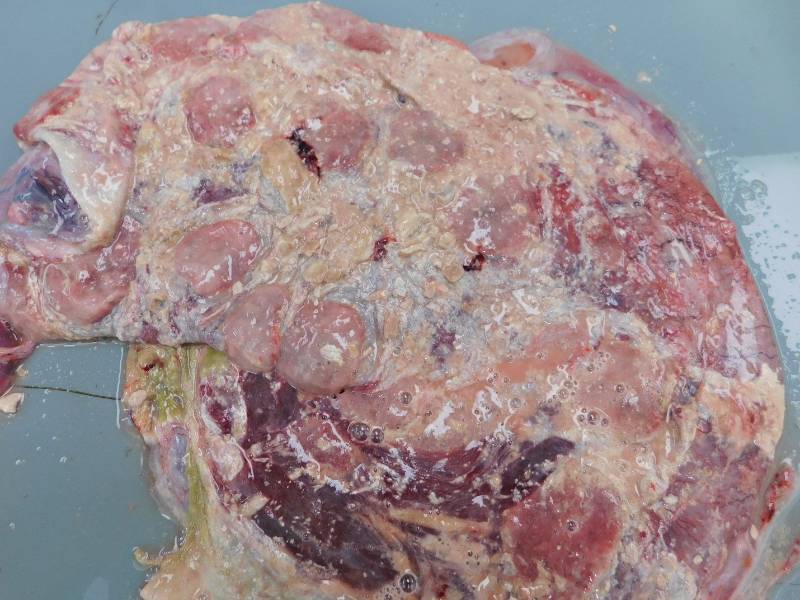
The case described is loosely based on a case submitted to UVDL. Details have been changed and added or omitted by the author.
It's spring. Lambing is due to start in a week, and several ewes have aborted lambs and had small weak lambs that only survive for hours after birth. The owner submits several lambs and associated placentas to the diagnostic laboratory for necropsy. The fetuses are all autolyzed, and the placentas look like the included image.
Case Summary
The first major point is that there are very few pathognomonic gross lesions in small ruminant abortions and observation of the placenta and/or fetuses without further testing is NOT an accurate way to diagnose the cause.
Three important and highly contagious bacterial causes of ovine abortion are Campylobacter spp., Chlamydophila spp., and Coxiella burnetii. All can cause late-term abortions, stillborn lambs, and the birth of weak lambs and may result in abortion storms where many or most of the ewes in the flock abort. They are generally indistinguishable by gross necropsy.
Occasionally, in cases of Campylobacter fetus subspecies fetus or Campylobacter jejuni abortions, small (1cm) yellow lesions (necrotic foci) may be seen in the fetal liver. However, in 33 years of looking at aborted feti, I have seen this lesion only a handful of times.
The most common cause of abortion in sheep that I have seen in Utah has been Chlamydophila abortus. It is also known as Enzootic Abortion of Ewes. The placenta can be minimally affected (that is, not look like the one in the photo!) or may have reddish-brown cotyledons and a thickened brown intercotyledonary area. Ewes tend to abort in late gestation and are usually not sick themselves. In both Campylobacter spp. abortions and Chlamydophila spp. abortions, vaccines are available and treatment of ewes with oxytetracycline or tetracycline should help reduce abortions even in the face of an outbreak.
Another cause of abortions in small ruminants that we have been seeing more often is Coxiella burnetii, the causative agent of Q Fever. Coxiella burnetii and Chlamydophila abortus are both intracellular bacteria we used to diagnose them by staining impression smears of cotyledons with acid-fast stains. Unfortunately, it is difficult to differentiate these two intracellular bacteria by staining alone. Luckily, we now have much more sensitive and specific tests for detection of the pathogens including PCR (polymerase chain reaction, a method to amplify and detect the DNA or RNA of organisms). Q Fever was first described in Australia and was named Q Fever or Query Fever because the cause was unknown. Coxiella burnetii causes a variety of signs and symptoms in animals (small ruminants, cattle, cats, wildlife) and humans including fever, pneumonia, and vomiting, as well as reproductive disease. The time and temperature to pasteurize milk (1450F for 30 minutes or 1610F for 15 seconds) were based on conditions needed to kill Coxiella burnetii and it can be spread by ingestion of raw milk as well as aerosol spread. Coxiella burnetii can also be transmitted by insects. There is no vaccine available in this country for Q Fever.
As stated above, these three bacterial organisms are highly contagious and, very importantly, can cause serious disease in humans. Pregnant women should not work around ewes during lambing season because of the risk of contracting Coxiella burnetii or Chlamydophila abortus, both of which can cause abortions in humans. In addition, Campylobacter jejuni is one of the more common causes of enteric disease and diarrhea in humans. It is usually a food-borne infection but can also be acquired by contact with animals shedding the bacterium.
Other causes of ovine abortion seen in this country tend to be (though not always) more sporadic and less likely to result in abortion storms. Salmonella spp. infections may result in abortions. Usually, in these cases, the ewes are clinically sick. Listeria monocytogenes may cause abortions in sheep and goats. It is also a potentially zoonotic infection. Pregnant women exposed to this bacterium may suffer severe reproductive effects such as abortion, stillborn babies, and babies born with hydrocephalus. The more common route of exposure is through ingestion of contaminated food, but exposure to aborting small ruminants is a possible source.
Brucella ovis is a common cause of ram epididymitis in the western United States. It can also cause late-term abortions, stillbirths, and weak lambs. Brucella melitensis is rare in the U.S. but, in some countries, is a significant cause of abortions in small ruminants and zoonotic disease in humans. Brucella ovis has NOT been shown to have high zoonotic potential. An important cause of protozoal abortion in ewes is Toxoplasma gondii. It is more common in goats. This is another potentially zoonotic infection of particular risk to pregnant women and immunosuppressed people. In pregnant women, it may cause abortion and congenital abnormalities. Exposure to cat feces is not the most frequent method of exposure for human beings. Ingesting undercooked meat is a more common source of infection in humans. Also, exposure to aborting ruminants is a possible source for humans. In sheep and goats, accidental ingestion of cat feces in the feed is a source of infection (the cat is the definitive host of the protozoa).
Viral causes of abortion, stillborn lambs, and congenital abnormalities in sheep include bluetongue and Cache Valley virus. Both are vector-borne diseases. Mosquitos transmit Cache Valley virus. We have occasionally seen cases, and stillborn lambs and live lambs born with congenital limb abnormalities are the more common presentations seen rather than abortions.
Going back to the placenta pictured in this case, the cause was actually Coxiella burnetii (Q Fever).
Important concluding comments:
- Many of the infectious causes of small ruminant abortion are zoonotic and several are of particular concern for pregnant women. Pregnant women should avoid working with small ruminants during abortion storms.
- Often, the fetal tissues, placenta, and birth fluids contain large amounts of infectious pathogen and these tissues should be removed and destroyed (burnt, buried, or composted away from the sheep flock). Gloves should be worn when handling this material and dogs, cats, and wild animals should not be allowed to ingest fetal tissues.
- If possible, isolate aborting ewes from other animals on the farm.
- If possible, remove organic material from facilities housing aborting ewes and disinfect the facility. If the ewes are in a field, removing soil contaminated with birthing fluids may reduce transmission to other ewes.
- If possible, do not allow dogs, cats, and wildlife to defecate in small ruminant feed (grain, hay, and silage).
- Often, the gross appearance of the placenta and aborted lambs is not specific for cause, and submission to a veterinary diagnostic lab is recommended for accurate diagnosis. Remember that including the placenta in the submission will greatly increase the chances of an accurate diagnosis.
- Also, don’t forget non-infectious factors that may influence reproductive health, such as nutrition including mineral supplements. Do not use bovine or equine mineral supplements for sheep as the copper levels may be too high.
- It is best not to transport heavily pregnant ewes because of the increased risk of pregnancy toxemia and other metabolic problems that may result in death of the ewe and lambs.
References
- Most of this information is from personal experience and teaching veterinary medicine students. I did check some information in the Merck Veterinary Manual to be certain I was giving accurate information.